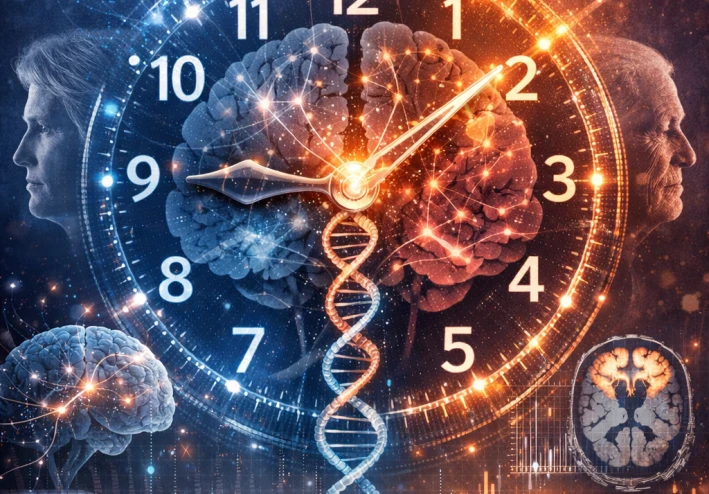
The Alzheimer's Clock: A New Era of Prediction
For decades, an Alzheimer's diagnosis has been a cruel game of hindsight. By the time the telltale symptoms of memory loss and confusion appeared, the disease had already been ravaging the brain for years, perhaps decades. Patients and their families were left with a devastating reality and no time to prepare or intervene effectively.
That era is ending. In a landmark advancement published in Nature Medicine, an international team of researchers has unveiled a powerful new approach that does more than just identify risk—it can predict, with remarkable accuracy, approximately when a person's Alzheimer's symptoms will begin . This isn't a crystal ball, but a sophisticated "clock model" built on a simple blood test, ushering in a new age of proactive and personalized dementia care.
Chapter 1: The Hands of the Clock: Understanding p-tau217
The heart of this predictive revolution is a biological marker, or biomarker, known as plasma p-tau217. This protein is a fragment of the tau protein, which forms destructive tangles inside the neurons of the brain—a hallmark of Alzheimer's disease. As these tangles accumulate, tau proteins are phosphorylated and released into the bloodstream, where they can be measured.
The new research focuses specifically on %p-tau217, the ratio of this phosphorylated tau to the non-phosphorylated version . By analyzing longitudinal data from over 600 participants in the Knight Alzheimer's Disease Research Center and the Alzheimer's Disease Neuroimaging Initiative (ADNI), scientists observed that the trajectory of %p-tau217 follows a surprisingly consistent and predictable path once it begins to rise .
This consistency is the key. Just as the steady tick of a clock's second hand allows you to tell the time, the steady rise of %p-tau217 allows researchers to tell how far along the path to symptoms a person is.
Chapter 2: Reading the Time: From Biology to Prediction
How does a single blood test translate into a prediction with a specific timeline? The research team built statistical "clock models" (specifically, TIRA and SILA models) that map the relationship between %p-tau217 levels and time .
Think of it this way: if you see a man on a train platform at a specific point, and you know the train's exact route and speed, you can estimate when he left his last station and, crucially, when he will arrive at his destination. The %p-tau217 clock works similarly. By pinpointing a person's current biomarker level, the model can look backward to estimate when their pathology began, and more importantly, project forward to predict when the "destination" of mild cognitive impairment or dementia will be reached.
The results are striking. The model was able to estimate the number of years a person has before developing Alzheimer's symptoms with a median absolute error of just 3.0 to 3.7 years . For a disease whose progression has long been considered a terrifying unknown, this level of precision is transformative. A web-based application has even been developed to allow researchers to visualize these trajectories .
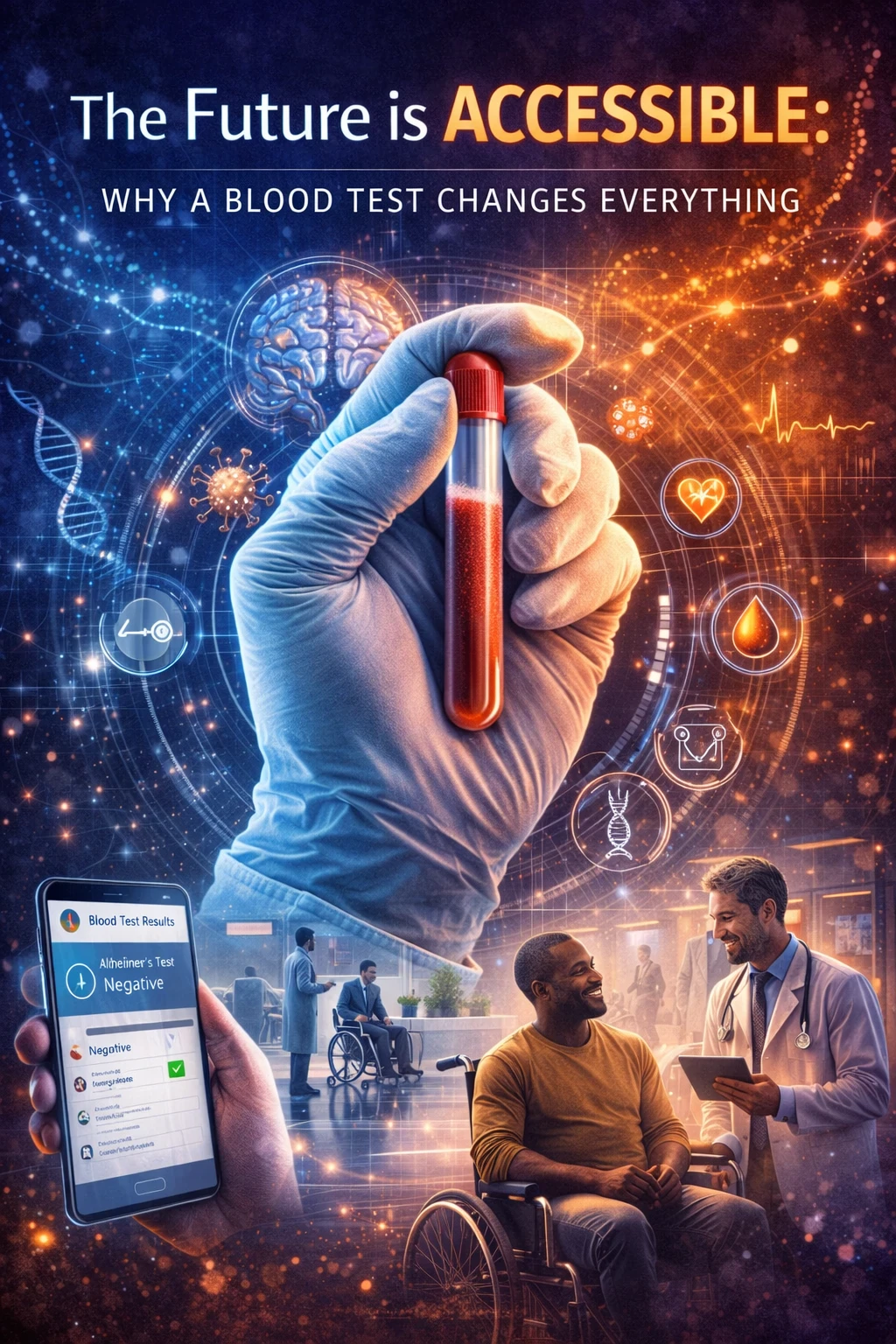
Chapter 3: The Future is Accessible: Why a Blood Test Changes Everything
Previously, predicting Alzheimer's with this level of granularity was only possible using expensive and inaccessible tools like amyloid and tau Positron Emission Tomography (PET) scans . While effective, PET scans are prohibitively costly for widespread screening and are not available in many communities.
The new plasma %p-tau217 clock shatters these barriers. A simple blood draw is minimally invasive, far cheaper, and can be administered in a standard clinic . This accessibility opens the door to integrating predictive testing into routine healthcare, much like cholesterol tests are used today to assess heart disease risk .
This shift is perfectly timed. In 2025, the EU approved the first disease-modifying therapies that target amyloid plaques . These new drugs are most effective in the early stages of the disease, before significant brain damage has occurred. The blood test provides the crucial tool to identify the ideal candidates for these therapies at precisely the right moment to maximize their benefit.
Chapter 4: Beyond the Clock: A Symphony of Predictive Tools
While the p-tau217 clock is a headline-grabbing breakthrough, it is part of a larger symphony of innovation in Alzheimer's prediction. Other research is rapidly advancing, promising a future of even more accurate and personalized forecasts.
AI and Machine Learning: Researchers are using machine learning (like XGBoost models) to integrate multiple data types—including PET imaging, genetic risk (APOE4), age, and sex—to forecast the rate of tau accumulation in the brain with high accuracy .
Multimodal Models: By combining 3D MRI scans with cognitive and genetic indicators, scientists have developed models that can forecast an individual's cognitive trajectory up to four years in advance and stratify patients into distinct prognostic subgroups (e.g., "Low," "Mild," and "Fast" progression) .
Precision Biophysics: Novel algorithms like "StaND" (Stage-based Network Diffusion) combine statistical disease staging with biophysical modeling to predict how tau protein spreads through an individual's brain network over time, using just a single scan .
Lifetime Risk Tools: Large-scale studies, such as the Mayo Clinic Study of Aging, have created tools that estimate a person's lifetime risk of developing mild cognitive impairment or dementia based on age, sex, genetic status, and brain amyloid levels .
These diverse approaches are converging on a single point: the future of Alzheimer's care is predictive, personalized, and proactive.
Chapter 5: Navigating the New World: Promise and Caution
The ability to predict the onset of Alzheimer's symptoms is a double-edged sword, carrying profound ethical and practical implications.
The Promise:
Clinical Trials: The most immediate impact will be on research. The clock model allows for the selection of participants who are most likely to develop symptoms during a trial's timeframe, making studies faster, smaller, and more powerful .
Planning and Agency: For individuals, knowing the timeline provides a window of opportunity. It allows for lifestyle changes that may delay onset, financial and legal planning, and making the most of healthy years .
Targeted Therapy: It paves the way for a future where treatment begins not at the first sign of memory loss, but at the first sign of biological change .
The Caution:
Experts are clear that these predictive tools are currently for research use only . There is immense responsibility in disclosing such life-altering information. As Jean Georges of Alzheimer Europe notes, "Dementia risk prediction comes with ethical, legal and social implications. Disclosure should always be approached in an open, honest, empathetic and compassionate manner" .
No test is 100% accurate, and a prediction is not a destiny. The goal is not to burden people with a countdown, but to empower them—and their doctors—with the foresight needed to change the ending.
Conclusion: Turning Back the Clock on Alzheimer's
For the first time, we are not just watching the final stages of Alzheimer's unfold; we are learning to read its earliest whispers. The development of the plasma p-tau217 clock model, alongside other cutting-edge predictive tools, represents a fundamental shift in the fight against this devastating disease. We are moving from a reactive stance of treating late-stage symptoms to a proactive stance of prediction and early intervention. This new approach doesn't just tell us the time; it offers us a chance to act before it's too late.