



In this article
Breastfeeding vs. Formula: Comparing Nutritional and Immunological Benefits and When Each Is Used
1. Breastfeeding and Formula: What Is the Main Difference?
The comparison begins with a crucial fact: breast milk is not merely a source of calories, protein, and fat; it is a biological food whose composition changes as the baby grows, and it contains antibodies and components that support the immune system. The World Health Organization (WHO) and UNICEF recommend initiating breastfeeding within the first hour after birth, exclusively breastfeeding for the first six months, and then introducing appropriate complementary foods while continuing breastfeeding up to the age of two or beyond. Similarly, the American Academy of Pediatrics recommends exclusive breastfeeding for about six months, continuing thereafter based on the mother's and baby's preferences.

Infant formula, on the other hand, is a regulated nutritional alternative designed to meet a baby's nutritional needs when breastfeeding is not possible, sufficient, or desired. Commercial infant formulas are subject to specific requirements regarding nutritional content and safety. Therefore, formula should not be viewed simply as ordinary diluted milk, nor should it be replaced by cow's milk or plant-based beverages during the first year of life.
2. Nutritional Value and Immunity: Where Does the Difference Lie?
Breast milk is distinguished by its ability to adapt to the baby's needs, in addition to containing immunological components and antibodies that help protect the infant against certain infections. The Centers for Disease Control and Prevention (CDC) indicate that breastfeeding is associated with a reduced risk of various childhood illnesses—including certain ear infections and gastrointestinal disorders—and offers health benefits for the mother as well.
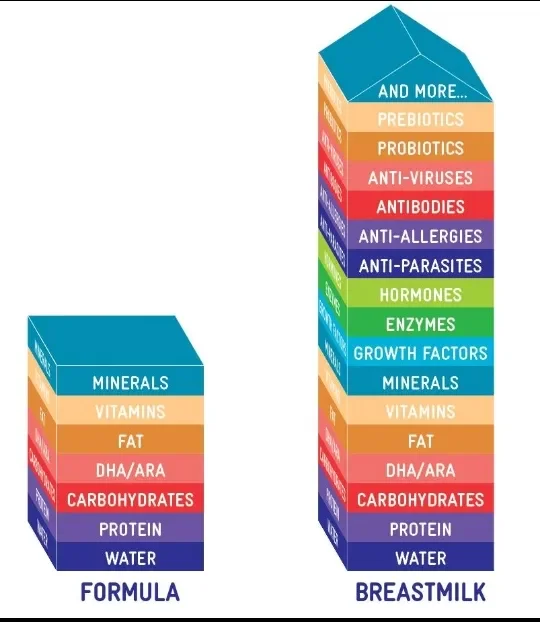
Formula, for its part, provides the essential nutrients required for an infant's growth, provided the product appropriate for the child's age is used correctly. However, its composition does not replicate all the biological properties of breast milk, nor does it provide the antibodies and immune components naturally found in human milk. Consequently, a nutritional comparison goes beyond simply asking which contains more protein, fat, or vitamins; the distinction also lies in the nature of the ingredients and how they function within the child's body.
3. Is formula feeding always less safe?
Safety depends not only on the type of nutrition but also on preparation, storage, and hygiene practices. With powdered formula, one must strictly adhere to the water-to-powder ratios specified on the packaging; using too much water can dilute nutritional value, while using too little can lead to excessive concentration of nutrients, potentially causing dehydration and placing strain on the kidneys and digestive system. Furthermore, the powder is not necessarily sterile, requiring careful preparation—especially for newborns, premature infants, or those with compromised immune systems.
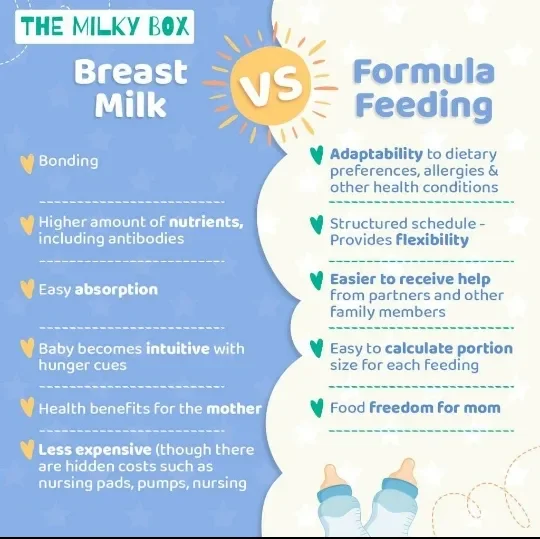
One crucial point must not be overlooked: homemade infant formulas should never be prepared. The U.S. Food and Drug Administration (FDA) warns against such recipes, as they may lack essential nutrients or contain inappropriate levels of certain minerals and vitamins, in addition to carrying a risk of contamination. Conversely, breastfeeding does not mean an absence of challenges; a mother may require professional assistance if she experiences pain, difficulty with the baby latching, or concerns about whether her milk supply is sufficient.
4. What about long-term growth and health?
Breastfeeding is associated with a range of short- and long-term health benefits; however, it is important to understand the evidence without interpreting it as an absolute guarantee. Medical sources indicate a lower risk of certain infections and health conditions among breastfed infants, and there are also health benefits for the mother. At the same time, individual outcomes vary from child to child and are influenced by many factors, including health status, nutrition, environment, and medical care.
Therefore, the inclusion of infant formula in a baby's diet does not automatically mean their growth will be poor. Commercial infant formulas can serve as a primary source of nutrition when used according to medical and manufacturing guidelines. Some infants may require specialized formulas due to specific health conditions; in such cases, the choice of formula becomes part of medical care rather than a general dietary decision.
5. Mixed feeding: Can the two methods be combined?
Yes, some families combine breast milk and infant formula—a practice known as mixed feeding. While this option may be suitable in various circumstances, the method and timing of combining them can affect the mother's milk supply. Consulting a pediatrician or a lactation specialist can be helpful, especially if the goal is to continue breastfeeding. The American Academy of Pediatrics emphasizes that decisions regarding infant feeding should be supported by appropriate medical guidance and made without pressure or feelings of guilt.
Frequently Asked Questions:
Is breast milk nutritionally superior to infant formula? Biologically, breast milk contains immune-boosting components and dynamic properties that adapt to the child's developmental stages—qualities that infant formula cannot fully replicate. However, when used correctly, infant formula is designed to meet an infant's nutritional needs.
Can a baby be given formula instead of breast milk?
Yes, commercial infant formula can be used when breastfeeding is not possible, is insufficient, or is not the parents' preference. It is important to choose a formula appropriate for the baby's age and to prepare it according to the instructions.
Can breastfeeding and formula feeding be combined?
Yes, combining the two is possible in certain situations, provided the baby's needs and the mother's milk production are taken into account, and medical advice is sought if feeding or growth issues arise.
Which option is best for my baby?
There is no single answer that suits every family. Breastfeeding is medically recommended whenever possible, while infant formula serves as a regulated and important nutritional option when breastfeeding is not feasible or suitable. In specific medical cases, a pediatrician will determine the most appropriate feeding method.
Medical Disclaimer:
This article is for general health education purposes and does not replace an evaluation by a pediatrician or lactation specialist—especially if the baby is failing to gain weight, experiencing feeding difficulties, or showing signs of dehydration or illness.
Source
1. World Health Organization (WHO)
https://www.who.int/news-room/fact-sheets/detail/infant-and-young-child-feeding
2. Centers for Disease Control and Prevention (CDC)
https://www.cdc.gov/breastfeeding/features/breastfeeding-benefits.html
3. American Academy of Pediatrics (AAP)
4. U.S. Food and Drug Administration (FDA)
https://www.fda.gov/consumers/consumer-updates/infant-formula-safety-dos-and
World Health Organization. Infant and young child feeding. Updated August 4, 2026.
Centers for Disease Control and Prevention. Breastfeeding Benefits Both Baby and Mom. Updated July 30, 2026.
American Academy of Pediatrics. Meek JY, Noble L. Policy Statement: Breastfeeding and the Use of Human Milk. Pediatrics. 2022;150(1):e2022057988.
U.S. Food and Drug Administration. Infant Formula: Safety Do’s and Don’ts.
Keep up with Alkatp
Choose site notifications, email, or both. Guests can subscribe by email without an account.
Report this article
Tell our review team about a problem with this content. Your details will not be shown to the author or other readers.
Your report could not be sent. Please try again later.
Sign in to report an article





Discussion
comments (0)
Share a perspective. Start a thoughtful conversation.
please login to be able to comment