
في هذا المقال
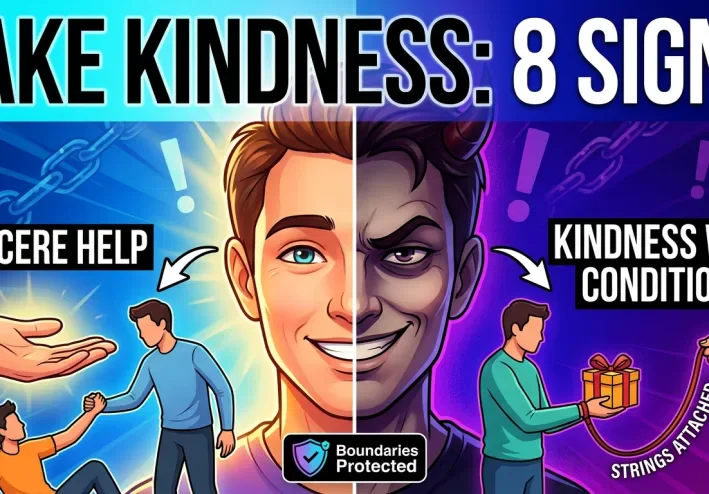
Fake Kindness and Eight Signs Worth Noticing

In the name of Allah, the Most Gracious, the Most Merciful.
May peace, mercy, and the blessings of Allah be upon you.
Reader note: This article provides general educational information about relationship behavior. It cannot establish another person's motives, diagnose a mental health condition, or determine the right response for an individual situation. The examples are hypothetical, and the suggested replies are options to consider where it is safe to speak openly. They do not replace an individual assessment by a qualified mental health professional.
You may spend months thinking that someone close to you is an unusually kind person. They check on you, offer to help, and choose words that make you feel important to them. Then, one day, you turn down a simple request and hear: "After everything I have done for you, this is how you repay me?"
The words stop you. You did not insult them or deny their kindness. You only said that you could not help this time. Yet you find yourself apologizing and explaining your circumstances. Perhaps you eventually agree just to escape the guilt.
These situations deserve attention, especially when they happen repeatedly. Kindness makes it easier to become close to people, but trust takes time. It grows through experiences that show how someone responds to our needs and our disagreements with them.
Fairness matters here. An ordinary courtesy is not deception, and someone who needs comfort is not necessarily manipulating the people around them. A smile or a look cannot tell us what another person is thinking. What we can observe is repeated behavior, its effect on us, and whether the person accepts responsibility when we raise a concern.
Here, "fake kindness" is an everyday description, not a clinical diagnosis. The eight patterns below are examples for reflection, not a validated psychological checklist. The sources support particular ideas about guilt, boundaries, and relationship responses; they do not establish a test for identifying someone's character. Context, frequency, and the effect of the behavior all matter.
1 They use their suffering to avoid responsibility
There is a meaningful difference between someone going through a difficult time who needs a listener and someone who uses their circumstances to shut down any discussion of their behavior.
Imagine telling a friend, "I waited an hour. You only needed to let me know that you were not coming." They respond by describing their problems and pressures, then accuse you of making their pain worse. The conversation ends with you comforting them, while nobody returns to the hour you spent waiting.
Their problems may be entirely real. The question is whether they can acknowledge their behavior while talking about those problems. Can they say, "I was distracted, but I should have called you"? Or does every concern you raise become evidence that you are cruel?
If this keeps happening, you can keep the conversation clear: "I know you are having a difficult time, and I am willing to listen. I also want us to talk about the appointment you missed."
Compassion does not require you to give up your right to raise a concern. Frequent complaints alone are not enough to judge someone. Pay attention to what happens when you ask them to take responsibility for their part.
2 They make refusing a request feel like betrayal
"I thought you were the person closest to me." "If you really cared about me, you would do it." You might hear these statements when you refuse to lend money you need yourself or decline a visit because you are tired.
At first, you try to prove that you care. You offer lengthy explanations, remind them of everything you have done before, and eventually give in. As this continues, you may start agreeing before considering whether you can manage the request, because you know how much blame will follow if you refuse.
Your friend may naturally feel disappointed when you cannot help. They can tell you that they feel upset and discuss it with you. What deserves attention is repeatedly turning your refusal into an accusation that you are selfish or ungrateful, then pressuring you until you change your answer.
Cleveland Clinic describes guilt-tripping as using a person's sense of obligation to influence what they do. Its guidance also notes that people may not recognize how much pressure they are applying. Harmful pressure does not always prove a deliberate plan to deceive. [1]
A short response may be enough: "You matter to me, but I cannot lend you this money." If the blame continues, repeat your decision without entering a lengthy argument in which you have to prove that you are a good person.
Feeling guilty does not automatically mean that you have done something wrong. Return to what actually happened. Did you break a clear promise, or did you decline a request you never agreed to in the first place?
3 They take up space but leave little room for your needs
You listen whenever they feel upset, check on them after every problem, and rearrange your time when they need you. But when you try to talk about something troubling you, they bring the conversation back to themselves or end the call quickly.
This can continue for a long time because you find an explanation on each occasion. Sometimes it is work. Sometimes it is exhaustion. Sometimes you tell yourself that they struggle to express themselves. Then you notice that you know the details of their life, while they do not even know that you have had a difficult week.
Relationships do not follow an exact accounting of giving and receiving. Someone who is ill or overwhelmed may need more support for a while. Another person may express care differently from you. Look at the relationship over time and consider what each person's circumstances allow.
Love is Respect explains that boundaries help people identify what they find comfortable and how they want others to treat them. Its guidance applies to friendships and family relationships as well as romantic ones. [2]
One possible starting point is to state your need clearly: "I need you to listen to me for a little while today." If they repeatedly ignore your request, mock it, or treat it as a burden, an option is to reduce what you give to an amount you can manage. Giving more than you can afford is unlikely to resolve the imbalance by itself.
4 They need praise after every favor
People who help us deserve thanks, and enjoying appreciation is natural. Some relationships become exhausting, though, because every favor leads to a long conversation about how wonderful the helper is.
You may thank someone for helping with a small task, only for them to keep asking, "Was I not the only person who stood by you?" If you simply thank them, they feel insulted or start dismissing the help others have offered. Gradually, you find yourself having to reassure them that they are the most loyal and important person in your life.
Seeking reassurance can have different explanations. It does not, by itself, establish bad intentions or a mental health condition. Focus on the behavior you can observe. Do they accept appreciation as you express it, or do they withdraw affection or criticize you when you do not give them as much as they want?
Thank them sincerely and in a way that reflects how you feel. You do not have to exaggerate or rank people according to what they have done for you to keep the affection of someone who helped you.
5 They bring up past favors whenever you disagree
Someone may drive you to an important appointment or stand by you during a crisis, and you remain sincerely grateful. Later, you disagree with them about something, and they bring up that favor as though it means they cannot be wrong and you cannot object.
You find yourself dealing with two issues at once: the current disagreement and the accusation that you have forgotten their kindness. You may even withdraw a valid point because you do not want to seem ungrateful.
Remembering what others have done for us is fair. Repeatedly invoking those favors to silence an objection puts you in an unequal position. You can say, "I am grateful for what you did, and I still appreciate it. But I disagree with you about this."
If they lent you money under a clear agreement, asking you to repay the loan is not holding a favor over your head. The concern here is using past help to demand your agreement on unrelated matters.
6 They praise you more when they want something
"You understand me better than anyone." "Nobody does this work as well as you." You hear something flattering, followed by a substantial request: taking on extra work, intervening in a situation that makes you uncomfortable, or giving up time you had set aside for yourself.
This does not mean that every compliment before a request is false. The person may genuinely trust you and need your help. But repeated situations reveal details worth noticing. Does this appreciation appear only when they want a favor? How do they treat you after you refuse?
The National Domestic Violence Hotline identifies excessive compliments or gifts that a partner later uses to manipulate someone as a possible sign of emotional abuse. This guidance concerns controlling behavior in romantic relationships; ordinary praise or generosity alone does not establish abuse. [3]
If you go from being "the most understanding person" to "an arrogant person" simply because you decline, pay attention to the change. Their praise has become tied to your willingness to cooperate.
Take a moment before agreeing. Thank them for their words, then consider the request itself. Does it fit your schedule? Would you accept it without the praise that came before it? You can say, "Thank you for trusting me, but I cannot take on this task."
7 They offer help and add conditions later
This differs slightly from bringing up old favors. Here, new obligations appear after the help, even though nobody mentioned them at the beginning.
A relative might help you get a job, then decide that this gives them the right to choose your friends or interfere in how you spend your salary. Someone might give you a gift, then become angry because you have not devoted all your time to them, as though accepting the gift meant accepting conditions you never heard.
People have the right to set limits on what they offer. Someone can say, "I can help for two hours only," or explain that the money is a loan. Being clear allows you to accept or decline while knowing what you are agreeing to.
When conditions appear later and reach into your personal decisions, you have the right to object: "I appreciate your help, but we did not agree to this, and this decision is mine."
If you notice this pattern with a particular person, clarify the terms of any help before accepting it. It may be better to find another option you can afford than to enter another arrangement in which the other person decides your obligations alone.
8 They belittle your success or turn the attention back to themselves
You tell a friend about a promotion you waited a long time for, and they reply, "Perhaps they could not find anyone else." Or you share the news that your small business is doing well, and they immediately start talking about someone who earns much more than you.
Those words may hurt more than direct criticism because you were not asking for a complete assessment of your life. You wanted to share good news with someone close to you.
In a 2004 paper, Shelly Gable and colleagues found that enthusiastic, constructive responses to positive news were associated with better relationship well-being, including intimacy and marital satisfaction. It would be an overreach to use that association to judge someone's motives from one reaction. [4]
Even so, do not judge their feelings by the enthusiasm on their face or the volume of their voice. Some people express themselves quietly. Others may hear your news during an exhausting day. Someone who loves you may experience a little envy or compare their situation with yours, then still treat you respectfully and offer support.
What deserves attention is repeated belittling, mockery, or attempts to embarrass you whenever you move forward. You can explain the effect of their words: "I was happy about the news and wanted to share it with you, but your comment dismissed the effort I put in." Then notice whether they try to understand and change their response or continue while blaming you for feeling hurt.
After reading these signs, you may think of several people. You may also remember a time when you behaved this way yourself. Any of us can ask for too much reassurance or speak out of frustration. Give sincere apologies and changed behavior their proper place when assessing a relationship. At the same time, do not let repeated apologies erase behavior that continues unchanged.
When it feels safe to discuss a concern, one approach is to begin with a specific incident and explain what you need: "When I decline a request, I need you to discuss it with me without accusing me of not caring about you." This is clearer than saying, "You are fake," and gives the other person an opportunity to respond. It cannot guarantee that they will respond respectfully.
Then decide what you can offer and follow through as consistently as possible. You can reduce the time you give to the relationship or decline favors that exceed your capacity. If the pressure continues, you may need more distance. You do not need to identify all eight signs before taking your discomfort seriously, and one sign alone cannot tell you everything about a person.
Someone may initially object to your boundaries and later understand them. Discussion can help where it is safe, but it is not an obligation when intimidation or threats are present. Love is Respect notes that fear of an angry or violent reaction to a boundary can be a warning sign. In that situation, support from a trusted person or an appropriate local service may help someone consider safer options before a confrontation. [2]
Keep investing in relationships where you find mutual care and room to disagree. Remember the person who accepted that you could not help, then checked on you the next day as usual. Trust grows in these ordinary moments. You learn that you can remain close, say "no" when you need to, and still be someone the other person respects.
Sources
The first three sources provide educational guidance. The fourth reports original relationship research. None validates the eight points above as a diagnostic tool.
[1] Cleveland Clinic. (2026, January 19). How To Recognize (and Stop) a Guilt Trip.
[2] Love is Respect. What are my boundaries?.
[3] National Domestic Violence Hotline. What Is Emotional Abuse.
[4] Gable, S. L., Reis, H. T., Impett, E. A., & Asher, E. R. (2004). What do you do when things go right? The intrapersonal and interpersonal benefits of sharing positive events. Journal of Personality and Social Psychology, 87(2), 228-245. DOI: 10.1037/0022-3514.87.2.228.
تابع جديد Ayaz Ali
اختر إشعارات الموقع أو البريد أو الاثنين. الزائر يقدر يشترك ببريده دون تسجيل حساب.
الإبلاغ عن المقال
لو لاحظت مشكلة في المحتوى، أرسلها لفريق المراجعة. لن تظهر بياناتك لكاتب المقال أو للقراء.
تعذّر إرسال البلاغ الآن. حاول مرة أخرى لاحقًا.
سجّل الدخول لإرسال بلاغ








النقاش
التعليقات (0)
فكرة تضيفها، أو سؤال يفتح حوارًا.
الرجاء تسجيل الدخول لتتمكن من التعليق