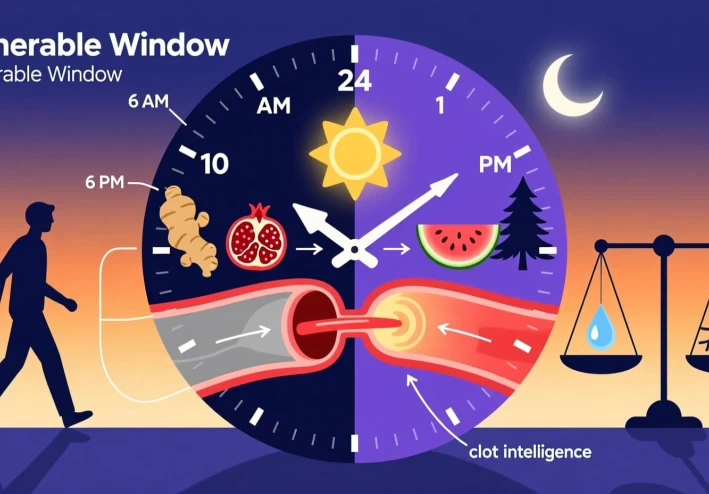
The Brain's Night Shift: Engineering Neurovascular Resilience Against Stroke
The Brain's Night Shift: Engineering Neurovascular Resilience Against Stroke

When we think of stroke prevention, a standard checklist comes to mind: manage blood pressure, lower cholesterol, quit smoking. This approach is vital, but it’s inherently defensive—it’s about risk reduction. What if we could build a more robust, intelligent, and resilient neurovascular system? Emerging science suggests we can shift from a defensive to a proactive strategy: from merely lowering risks to actively engineering neurovascular resilience
The most critical clue lies in the clock. The majority of ischemic strokes occur in the early morning hours. This is not coincidence but circadian vulnerability—a perfect storm of natural morning peaks in blood pressure, platelet activity, and inflammatory signals. Conventional medicine often delivers a flat, 24/7 defense (like a daily aspirin). The future of prevention is dynamic and timed. This article introduces a three-pillar protocol designed to fortify your brain’s circulation by working in harmony with your body’s natural rhythms, training your blood vessels, and intelligently modulating your clotting system
Chrono-Nutrition – Protecting the Vulnerable Hours
Your blood vessels follow a powerful daily rhythm. At night, the endothelium (the delicate lining of your arteries) reduces its production of nitric oxide, the molecule responsible for relaxing and dilating blood vessels. This sets the stage for the morning’s high-risk window
The Unconventional Strategy: Targeted Night & Morning Nutrition
The Evening Protocol: The Nitric Oxide Nightcap
Goal: To provide sustained nitric oxide support throughout the vulnerable night and early morning hours
The Science: L-Citrulline, an amino acid found in watermelon rind, is converted in the kidneys to L-Arginine, the precursor to nitric oxide. When paired with Pycnogenol (French maritime pine bark extract), studies show it enhances and prolongs this effect
The Action: 60 minutes before bed, take 1,500 mg of L-Citrulline with 100 mg of Pycnogenol. This isn’t a sleep aid; it’s vascular shift coverage, ensuring your cerebrovascular system has the tools it needs to maintain healthy dilation while you sleep
The Morning Protocol: The Gentle Anti-Thrombotic Ritual
Goal: To gently moderate the natural morning surge in platelet "stickiness"
The Science: Compounds in ginger (gingerols) and pomegranate (punicalagins) have demonstrated mild antiplatelet and antioxidant effects in research, helping to maintain healthy blood fluidity and protect LDL cholesterol from oxidation at the start of the day
The Action: Upon waking, drink a large glass of water with 1 tablespoon of freshly grated ginger and 2 oz of 100% pomegranate juice. Think of it as priming your vascular system for the day ahead
Endothelial Training – Transforming Your Vessels from Passive Pipes to Active Organs
Your endothelium is not just a lining; it’s a vast sensory organ. Its health is determined by the quality of blood flow it experiences. Smooth, rhythmic laminar flow keeps it calm and anti-inflammatory. Turbulent, erratic flow (from high pressure or stiffness) makes it dysfunctional and prone to atherosclerosis
The Unconventional Strategy: Exercise and Nutrients for Hemodynamic Health
Laminar Flow Exercise
The Science: Steady, rhythmic aerobic exercise promotes the healthy shear stress that "trains" endothelial cells to release protective substances
The Action: Prioritize consistent-paced cardio like brisk walking, swimming, or cycling where you can maintain a conversation. Crucially, incorporate a 10-15 minute post-meal walk. This directly counteracts the endothelial-stressing effects of a meal’s metabolic storm, improving blood sugar metabolism and vascular function simultaneously
Polyphenol Pulsing for Acute Signaling
The Science: Powerful plant polyphenols provide acute antioxidant and anti-inflammatory signals to the vasculature, improving endothelial function within hours of consumption
The Action: Implement 2-3 daily “pulses” of high-potency polyphenols between meals
Mid-Morning: A cup of green tea (for catechins)
Afternoon: A square of 90% dark chocolate (for flavonols) or a small glass of tart cherry juice (for anthocyanins)
With Dinner: Include deeply colored vegetables like red cabbage or beets (for betalains)
Clotting Intelligence – Moving Beyond "Thin Blood" to Balanced Hemostasis
Preventing a thrombotic stroke isn't about making your blood "thin"; it's about supporting a sophisticated, balanced system where clotting occurs appropriately—to seal a wound—and not pathologically, inside a brain artery
The Unconventional Strategy: Nutritional Support for Fibrin Balance and Platelet Membrane Health
Strategic Fibrinolytic Support
The Science: Fibrin is the mesh-like protein that forms clots. Over-accumulation is a risk. Enzymes like nattokinase (from fermented soy, natto) and serrapeptase have shown fibrinolytic activity in studies, supporting the body’s natural clean-up processes
The Action: Consider 2,000 FU (Fibrinolytic Units) of nattokinase or 120,000 SPU of serrapeptase on an empty stomach, 2-3 times per week. Critical Note: This is for prevention only. Do not use if on prescription anticoagulants (like warfarin, apixaban) without exhaustive doctor supervision
Omega-3 for Platelet Membrane Fluidity
The Science: The omega-3 fatty acids EPA and DHA get incorporated into the very membranes of your platelets, making them less reactive and less likely to aggregate excessively. This is a structural change, not just a temporary effect
The Action: Take a high-quality fish oil or algae supplement providing a combined 2-3 grams of EPA and DHA daily. Consistency is key to remodeling cell membranes over weeks and months
Becoming the Architect of Your Neurovascular Resilience
Stroke prevention is evolving from a passive checklist into an active discipline—a daily practice of cerebrovascular craftsmanship. By aligning your nutrition with your circadian rhythm (Pillar 1), training your endothelium with optimal blood flow (Pillar 2), and intelligently supporting your clotting balance (Pillar 3), you are not just avoiding a negative event
You are actively engineering a system defined by robustness, adaptability, and resilience. This protocol empowers you to work with your biology, transforming vulnerability into strength. Always integrate this foundational work with regular medical care and monitoring of traditional risk factors. Partner with your doctor, share this plan, and together, build a defense for your brain that is as dynamic and intelligent as the organ it protects
FAQs: Your Neurovascular Resilience Questions Answered
Q1: Is this protocol a replacement for my blood pressure or cholesterol medication
A: Absolutely not. This is a complementary, foundational lifestyle protocol. Do not alter or discontinue any prescribed medication without explicit guidance from your physician. The goal is to build underlying vascular health so that, under medical supervision, your medication needs can be optimally managed
Q2: I’m on aspirin for prevention. Can I still do the Clotting Intelligence pillar
A: The fibrinolytics (nattokinase/serrapeptase) should not be combined with aspirin or any anticoagulant/antiplatelet drug without close medical supervision, due to the potential for increased bleeding risk. The Omega-3 and dietary components (ginger, pomegranate) are generally safe but should still be discussed with your doctor. Transparency with your healthcare provider is essential
Q3: How soon can I expect to see benefits
A: Benefits are layered. Improved endothelial function (via flow-mediated dilation) can be measured within weeks of starting consistent exercise and polyphenol intake. Changes in platelet membrane composition from omega-3s take 3-6 months of consistent dosing. View this as a long-term investment in your vascular capital
Q4: Are there any side effects to the Evening Nitric Oxide protocol
A: L-Citrulline is very well-tolerated. A small percentage of people may experience mild digestive upset. Pycnogenol has an excellent safety profile. Some people report more vivid dreams initially, likely due to increased cerebral blood flow. If you have low blood pressure, monitor closely and consult your doctor
Q5: What’s the most important first step if I feel overwhelmed
A: Start with Pillar 2: Endothelial Training. Begin a daily 30-minute brisk walk and add one polyphenol pulse (like green tea) per day. This single step combines the powerful effects of laminar flow exercise and vascular-protective nutrition, offering a massive return on investment for your neurovascular health