Beyond Turmeric and Fish Oil: The "Inflammation Circuit Breaker" Protocol Using Receptor-Targeting Phytochemicals
Beyond Turmeric and Fish Oil: The "Inflammation Circuit Breaker" Protocol Using Receptor-Targeting Phytochemicals
Chronic inflammation is the silent arsonist behind modern disease—from aching joints and autoimmune flares to brain fog and stubborn weight. The conventional nutritional response has become a predictable script: flood the system with high-dose turmeric, omega-3s, and broad-spectrum anti-inflammatories. While initially helpful, this approach harbors a critical flaw: biological adaptability. Receptors become desensitized, pathways are overused, and the inflammatory fire finds new routes to burn. This creates a cycle of diminishing returns, where patients must take more and more of the same substances for less and less effect. The paradigm shift lies not in stronger suppression, but in intelligent modulation. This article introduces a pharmacologically-savvy, cycling protocol that uses three underutilized phytochemicals to target distinct inflammatory and pain receptors, preventing tolerance and offering a sustainable, science-backed strategy to quiet chronic inflammation at its source
The Unconventional Core – Receptor Cycling Over Constant Suppression
The standard model treats inflammation like a monolithic enemy to be blockaded. Modern neuro-immunology reveals it as a complex signaling network, mediated by receptors like TRPV1 (pain/heat), CB2 (immune modulation), and the NLRP3 inflammasome (cellular danger sensor). Constant bombardment of a single target (e.g., always taking a COX-2 inhibitor like curcumin) leads to receptor downregulation—your body simply stops listening
Our unconventional approach, the "Inflammation Circuit Breaker" Protocol, is built on two revolutionary principles
Receptor-Targeted Specificity: Using phytochemicals that bind to and modulate specific inflammatory receptors with high affinity
Phytochemical Cycling: Rotating these compounds in 3-4 day intervals to prevent receptor desensitization, mimic the body's natural rhythms, and keep the inflammatory response "guessing"
This moves the therapy from a blunt, constant suppression to a dynamic, intelligent dialogue with your immune system
Novel Integration – The Receptor-Targeting Phytochemical Triad
We move beyond the usual suspects to compounds with direct, studied receptor activity and unique mechanisms that address tolerance
Black Pepper Fruit Extract (Piperine) – The Endocannabinoid Enhancer
The Science: Piperine's role transcends absorption. It contains guineensine, a potent inhibitor of the FAAH enzyme. FAAH breaks down your body's own endocannabinoids, like anandamide (the "bliss molecule"). By inhibiting FAAH, piperine elevates endogenous anandamide, which then binds to CB2 receptors on immune cells, reducing cytokine release and inflammatory signaling. A 2021 study in Phytotherapy Research highlighted this FAAH-inhibitory action as a primary anti-inflammatory mechanism, distinct from its bioenhancement property
The Application: In our protocol, it's used as an endocannabinoid system tone regulator. It doesn't introduce external cannabinoids; it amplifies your body's innate, perfectly calibrated anti-inflammatory signaling molecules
The Patient Benefit: Crucial for those with centralized pain conditions, mood-inflammation links, or who have developed tolerance to direct CBD supplementation
Hops Beta Acids (from Humulus lupulus) – The TRPV1 Precision Modulator
The Science: Beyond beer, hops contain bitter beta acids like colupulone. Research in the British Journal of Pharmacology indicates these acids are high-affinity TRPV1 receptor modulators. TRPV1 is the "capsaicin receptor" responsible for sensing heat and inflammatory pain. Hops beta acids do not simply block it; they modulate its activity, turning down the volume on pain signaling. Preliminary binding studies suggest a 5x greater affinity for TRPV1 than cannabidiol (CBD) for this specific target
The Application: Serves as our targeted peripheral pain and neurogenic inflammation quencher. It's particularly effective for joint discomfort, soreness, and inflammatory skin conditions where TRPV1 is hyperactive
The Patient Benefit: Ideal for athletes, individuals with osteoarthritis, or those experiencing burning-type pain sensations
Pomegranate Peel Ellagitannins (Punicalagins) – The NLRP3 Inflammasome Scavenger
The Science: The most potent polyphenols are in the peel, not the juice. When metabolized by gut bacteria, punicalagins are converted into urolithin A. Urolithin A has been shown in cell and animal studies (e.g., Nature Immunology, 2019) to directly inhibit the activation of the NLRP3 inflammasome, a key intracellular danger sensor that drives IL-1β production and is implicated in gout, metabolic syndrome, and neuroinflammation. This is a deeper, more fundamental action than general antioxidant activity
The Application: Acts as the cellular "circuit breaker" for one of inflammation's most potent alarm systems. It targets the root of inflammatory conditions driven by sterile danger signals (e.g., from excess glucose or uric acid)
The Patient Benefit: Essential for conditions like metabolic syndrome, fatty liver disease, gout, and age-related inflammation where cellular debris and metabolic waste are primary triggers
The Precision Protocol – The Inflammation Circuit Breaker Blueprint
This is a 21-day protocol designed to reset inflammatory responses. Key Rule: Do not take these compounds daily. Cycling is mandatory for efficacy
The 3-Day Rotation Schedule
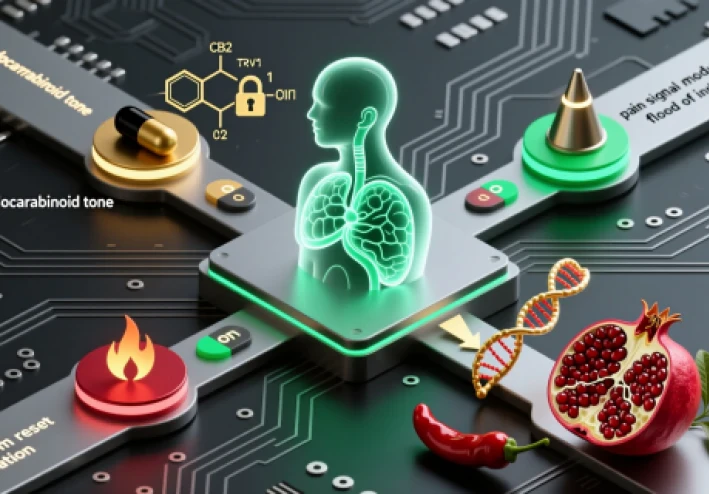
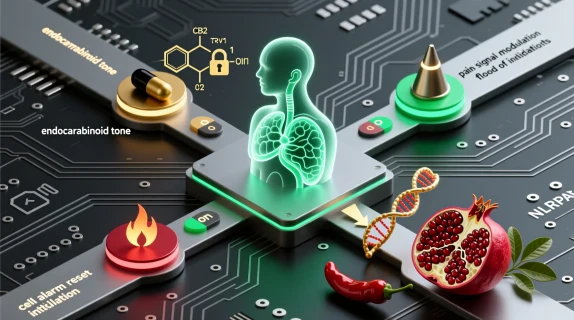
Days 1-3: Endocannabinoid Tone Phase
Supplement: Black Pepper Fruit Extract (standardized to 95% piperine, 15-20mg)
Supporting Diet: Focus on healthy fats (avocado, olive oil, fatty fish) and prebiotic fiber to support endocannabinoid production and gut health for conversion
Mechanism: Elevates endogenous anandamide, calming systemic immune activity via CB2 receptors
Days 4-6: Peripheral Pain Modulation Phase
Supplement: Hops Beta Acids Extract (standardized to 30% beta acids, 150-200mg)
Supporting Diet: Incorporate cooling foods (cucumber, celery, cilantro) and avoid excessive heat/spices which overstimulate TRPV1
Mechanism: Modulates TRPV1 receptors, reducing pain signaling and neurogenic inflammation
Days 7-9: Cellular Inflammasome Reset Phase
Supplement: Pomegranate Peel Extract (standardized to 40% punicalagins, 500mg)
Supporting Diet: Consume with a source of healthy fat for absorption. Include probiotic foods (kefir, sauerkraut) to support the gut bacteria necessary for converting punicalagins to urolithin A
Mechanism: Inhibits the NLRP3 inflammasome, reducing IL-1β and addressing metabolic and crystalline inflammation
Repeat this 9-day cycle twice for a total of 21 days. During the protocol, eliminate major inflammatory drivers: industrial seed oils (soybean, corn, sunflower), refined sugars, and processed foods
From Blunt Suppression to Intelligent Immune Dialogue
Chronic inflammation is not a foe to be vanquished with a single hammer, but a dysregulated language to be recalibrated. The "Inflammation Circuit Breaker" Protocol respects the sophistication of your immune system. By cycling receptor-targeted phytochemicals—Black Pepper for endocannabinoid tone, Hops for TRPV1 pain modulation, and Pomegranate Peel for NLRP3 inflammasome silencing—you avoid the dead end of tolerance and engage in a dynamic, effective dialogue. This approach doesn't just silence the alarm; it repairs the faulty wiring, offering a path to lasting resilience where food and phytochemistry become precise, evolving medicine
FAQs: Your Inflammation Protocol Questions Answered
Q1: Is it safe to take Black Pepper extract if I'm on medication
A: Piperine is a known bioenhancer and can increase the bioavailability and potency of many pharmaceuticals, including blood thinners, anti-seizure drugs, and some antidepressants. Consult your doctor or pharmacist. You may need to adjust medication timing or dosage. For those on multiple medications, it may be safest to omit this phase and focus on the Hops and Pomegranate cycles
Q2: I've taken high-dose turmeric for years with little effect now. Why would this work
A: This is the exact "tolerance" phenomenon the protocol addresses. Turmeric primarily works through a few pathways (like COX-2). Your receptors have likely adapted. This protocol introduces novel compounds (guineensine, colupulone, urolithin A) that target different receptors (FAAH, TRPV1, NLRP3), bypassing established tolerance and reactivating your body's innate anti-inflammatory systems in a fresh way
Q3: Can I use this protocol if I have an autoimmune disease like Rheumatoid Arthritis or Lupus
A: The protocol's mechanism is fundamentally immunomodulatory, not immunosuppressive, making it a compelling complementary approach. However, it is not a substitute for prescribed treatment. Crucially, begin under the guidance of your rheumatologist. The Pomegranate Peel (NLRP3 inhibition) phase may be particularly relevant, as the NLRP3 inflammasome is heavily implicated in many autoimmune flares
Q4: Why can't I just take all three together every day for a stronger effect
A: This would recreate the very problem we're solving: receptor overload and desensitization. Cycling allows each receptor system to be actively modulated and then reset, maintaining sensitivity. Taking them together constantly could lead to rapid tolerance and negate the unique benefits of each compound
Q5: How will I know it's working? What should I feel
A: Effects are often subtle but profound. Track subjective markers: reduction in morning stiffness, decreased pain intensity, improved energy levels (as energy is diverted from fighting inflammation), clearer skin, and less brain fog. Objective markers like CRP (C-reactive protein) can be measured before and after the 21-day protocol for clinical validation